When did you learn about the field? What inspired you to enter the field?
I found my way into medical physics when I stumbled across an internship during my junior year at Boston College. The internship placed me at Massachusetts General Hospital working under Dr. Peter Biggs. Dr. Biggs helped me bridge the gap between my interest in physics and desire to participate in the medical field. This combination was foreign to me at the time and I am fortunate to have had such a great undergraduate experience. It sparked my interest in the field and showed me the impact that strong technical physics knowledge can have on in both the clinical and research settings.
Can you talk about your role in theranostics? What are your responsibilities?
I am the Director of Theranostic Physics in the Department of Human Oncology. In that role I participate in the care and management of patients undergoing radiopharmaceutical therapy. With the technology that we have available at UW, we are able to perform personalized, voxel-level dosimetry for these patients. Our dosimetry process provides our physicians with a rich set of data to better inform decisions on how to care for their patients. This is a clinical service that continues to grow and keeps us very busy.
What is your research?
My theranostics research is focused on advancing personalized dosimetry, implementing new imaging strategies, and investigating novel radiopharmaceuticals. In particular, I am currently working on refining an imaging method that will help us to map the active bone marrow distribution in our patients. We then hope to use our state-of-the-art dosimetry methods to calculate the dose to this active bone marrow volume that will help us better predict marrow related toxicities. A better understanding of this relationship between dose and marrow toxicity will help us to personalize treatment for radiopharmaceutical patients and improve their clinical outcomes.
What aspect of theranostics most excites you? What are you looking forward to seeing in the next couple years in the field?
I think in the next few years we will really see a push toward personalized radiopharmaceutical therapy as opposed to the one-size-fits-all paradigm that is currently implemented. Although studies clearly demonstrate the benefits of individualized dosing, implementing it clinically remains not only challenging but also prohibited under current drug labeling. Hopefully, we will see clinical trials, that test these theories robustly that will enable widespread adaptation and truly bring about an era of personalized medicine in the field of theranostics.
Do you have any advice for students and trainees looking to follow your career path and get involved in the field?
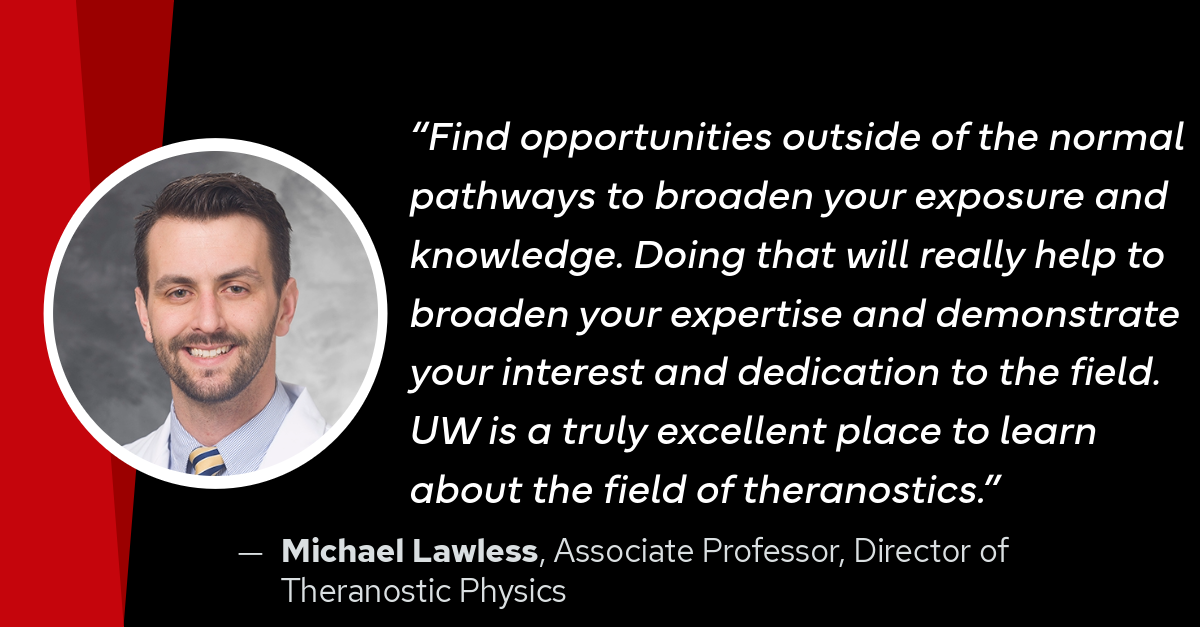
My advice would be to seek out opportunities in the areas that interest you and pursue them vigorously. Find opportunities outside of the normal pathways to broaden your exposure and knowledge. Doing that will really help to broaden your expertise and demonstrate your interest and dedication to the field. UW is a truly excellent place to learn about the field of theranostics.