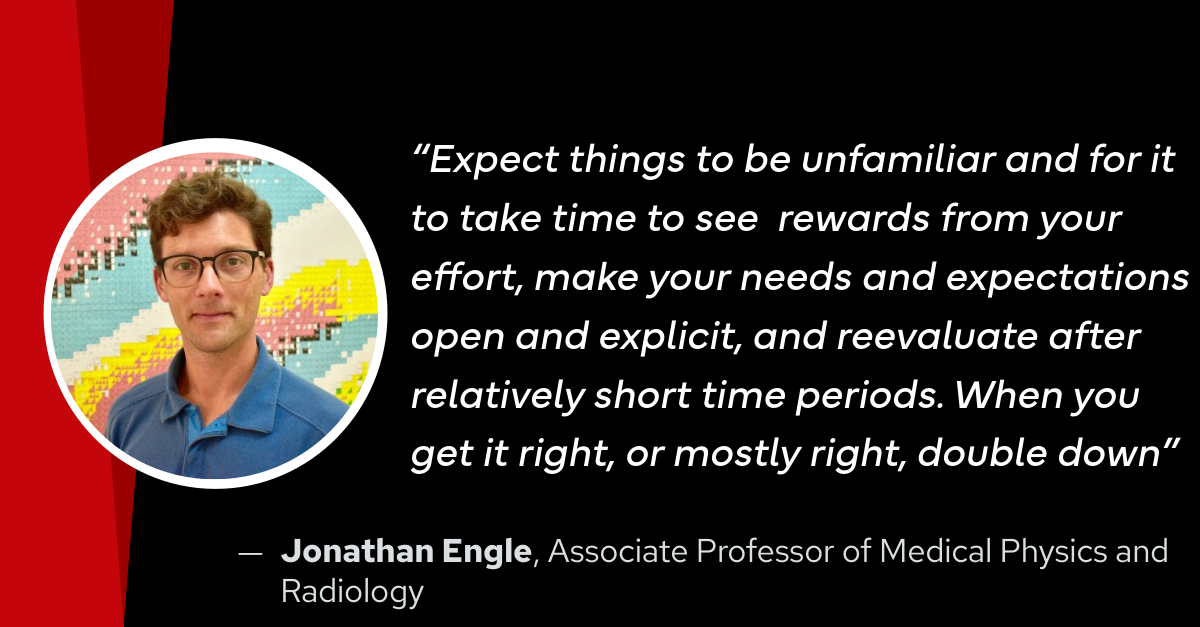
1. Can you please introduce yourself?
Jonathan Engle, Associate Professor, Departments of Medical Physics and Radiology, Affiliations in Chemistry and Engineering Physics
I learned about the field of Medical Physics when I was working as a laboratory technician in Utah, while going back to school to earn my B.S. in Physics. My exposure to positron emission tomography (PET) imaging led me to graduate work making positron-emitting radionuclides with cyclotrons, and I was very fortunate to get to see the entire process from making an accelerator target to working with living research subjects, mice and human. I am still a little awed every time I see a new PET image of a new drug in a living subject — there’s nothing like seeing the physiology of novel and even well-known compounds revealed on screen with quantitative data.
2. Can you talk about your role in theranostics and particle therapy?
I research accelerator-based production and purification of new radionuclides and their applications in fundamental scientific inquiry, industry, and medicine. My day to day life involves work with students, supervising an active cyclotron laboratory full of nuclear engineers, physicists, radiochemists, nuclear chemists, and analytical chemists, necessary administrative affairs, and, as often as I can manage, time spent helping with or performing experiments at the bench or in the accelerator vault.
3. What aspect of theranostics and particle therapy most excites you? What are you looking forward to in the next few years?
I’m most excited by theranostic technologies that reduce the toxicity and side effects profile of treatments received by cancer patients. I think new radionuclides with different physical emissions have unmatched potential to change the way we think about cancer management practically and for the better, and their development in lab will be exciting.
4. Do you have any advice for students and trainees who are looking to follow your career path and get involved in the field?
My advice to those looking to get into one of the many theranostics-adjacent fields is to find a way to test your ambitions with experience. Do as much as you can to critically and honestly identify work that would be professionally satisfying and exciting, pluck up your courage, and approach field leaders, professors, and potential mentors to ask for help experience. Expect things to be unfamiliar and for it to take time to see rewards from your effort, make your needs and expectations open and explicit, and reevaluate after relatively short time periods (6–12 months). When you get it right, or mostly right, double down.