Can you please introduce yourself and your career path?
I am an Associate Professor in the Department of Human Oncology and a member of the UW Carbone Cancer Center. I completed my bachelor’s through PhD at the University of Florida, where I studied nuclear engineering and medical physics. I first learned about medical physics and proton therapy at the same time during my undergraduate training. My engineering advisor had been performing detection measurements at the UF Proton Therapy Institute and told me about the work taking place there while also explaining medical physics. Prior to that, I had been considering careers in biomedical engineering or medical school; however, when I heard about proton therapy and the field of medical physics, it immediately felt like the perfect fit. I went on to focus my PhD research on proton Monte Carlo dose calculations. After graduation, I completed residency training at the University of Pennsylvania, which was one of the few programs offering proton therapy experience at the time. Following residency, I began working full-time at the same institution as a proton physicist. Along the way, I have been fortunate to gain experience with three different proton systems, which has provided a valuable perspective on the technology and clinical implementation. For me, proton therapy and medical physics have always gone hand in hand.
Can you talk about your role in proton therapy?
Currently my second home is the proton gantry control room. We are actively commissioning the new proton system to ensure safe patient treatments in the future. Additionally, I am assisting with setting up workflows, documentation and planning guidelines. I have been involved in testing the integration between different systems, as well as commissioning advanced imaging technologies to ensure accurate proton dose calculations.
My research interests include functional lung imaging, Monte Carlo dosimetry, dual energy CT for proton therapy and reducing radiation-induced toxicities. I’ve investigated whether constraints derived from photon therapy treatments are appropriate for proton therapy. I am passionate about education and have lectured graduate students and medical residents on proton therapy basics and planning. I also mentored medical physics residents on their proton rotations and created a free online module for anyone looking to learn the basics of proton therapy: https://www.globalmedphys.com/trainingmodules.
What aspect of proton therapy most excites you? What are you looking forward to seeing in the next couple years in the field?
I am most excited about the expansion of proton therapy in the US and globally. Today, more than 120 proton therapy facilities are operating worldwide and approximately 65 additional centers are currently under construction or in development. Advances such as compact single-room systems and increasing clinical evidence are helping drive the democratization of proton therapy, expanding access beyond the areas in which they have been historically concentrated. For example, Uganda and Vietnam have recently announced they will be getting protons.
Do you have any advice for students and trainees looking to follow your career path and get involved in the field?
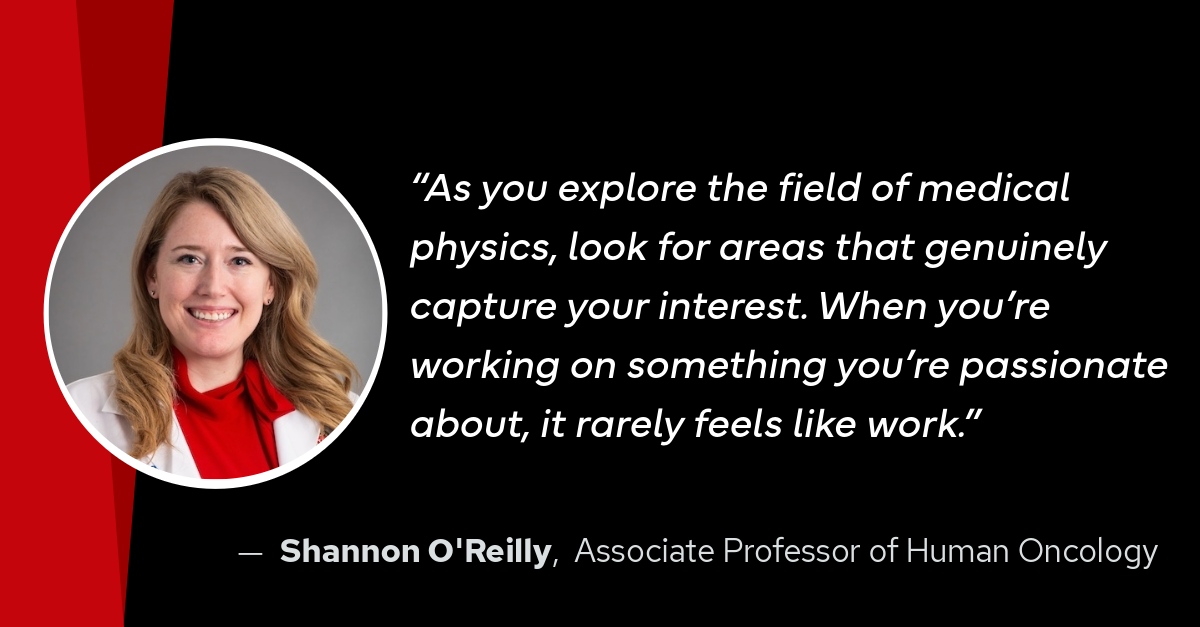
I would encourage students and trainees to attend local AAPM chapter events and take advantage of established fellowship and mentorship opportunities, such as the AAPM Mentorship Program, ICAMP, SUFP, and AMPERE. These programs are great ways to learn more about the career, build connections, and gain valuable experience. As you explore the field of medical physics, look for areas that genuinely capture your interest. When you’re working on something you’re passionate about, it rarely feels like work. I really enjoyed my PhD, as it gave me the chance to focus on proton therapy, a field that has remained exciting and meaningful to me ever since.