Can you please introduce yourself?
During my undergrad at Indiana University, I originally studied Astrophysics because I was fascinated by cosmology and the origins of the universe. I figured that if I was going to study science, it made the most sense to start at the literal beginning of time! Before my senior year, I participated in a summer research program where some of the other students were working on medical physics research at the IU proton therapy center. This was eye opening and helped me realize I could use my physics skills to have a direct helpful impact on people’s everyday lives. I then decided to pursue a PhD in medical physics here at UW. While I originally spent my first year working on research related to proton therapy, we eventually pivoted to radiopharmaceutical therapy (RPT) where my thesis was focused on developing a platform for performing patient-specific RPT dosimetry calculations. During that time, I realized there was an exciting opportunity to contribute meaningfully to this area, as RPT was still in its infancy compared to the more advanced state of external beam radiation therapy.
Can you talk about your role in theranostics? What are your responsibilities? What is your research? What does your day to day look like?
When I first joined the Department of Human Oncology about four years ago, our involvement in radiopharmaceutical therapy was fairly limited. Since then, we have established a collaborative, multi-department working group dedicated to RPT dosimetry – bringing together physicians, physicists, dosimetrists, technologists, nurses, researchers, and students from across Human Oncology, Nuclear Medicine, and Medical Physics. This group serves as champions for the development and implementation of new workflows, engaging key administrative and clinical stakeholders, and coordinating both clinical and research activities related to RPT dosimetry.
As a clinical therapy physicist, most of my time is spent collaborating with this team to develop and implement dosimetry workflows for radiopharmaceutical therapy patients. A few years ago, we first began performing patient-specific, voxelized dosimetry calculations for ¹⁷⁷Lu-PSMA-617 (Pluvicto®) and ¹⁷⁷Lu-DOTATATE (Lutathera®) based on serial SPECT/CT. My work has focused on figuring out how to setup this multi-department workflow including establishing processes for imaging, patient immobilization, image processing and QA, image registration, contouring, dosimetry calculations, and analysis. Specifically, I am interested in developing methods to commission and validate RPT dosimetry software to ensure accurate and reliable dose calculations. Since there aren’t any established guidelines in this area, I am also working as part of an AAPM Task Group to develop and publish best practices in this space. Lastly, another key part of my role is working closely with students, residents, and dosimetrists to train them on our RPT dosimetry workflow and also engaging in research to help expand both our clinical program and research efforts.
What aspect of theranostics most excites you? What are you looking forward to seeing in the next couple years in the field?
I’m personally very interested in theranostics-related educational initiatives because the limited training pipeline for radiopharmaceutical therapy creates a workforce gap that makes it challenging for the field to expand and grow. As a part of the ITPT Education and Training subcommittee, we are working on expanding theranostics education in a variety of ways across all learning levels from undergraduate students to current faculty here at UW. Even more specifically, as the director of the therapy medical physics residency program, I am especially interested in advancing educational initiatives for residents. Thus, I am working with several groups within AAPM and SDAMPP to help better define and strengthen theranostics education for medical physics residents. I’m very excited to help build stronger training pathways for medical physicists to support the growth of theranostics and radiopharmaceutical therapy.
Do you have any advice for students and trainees looking to follow your career path and get involved in the field?
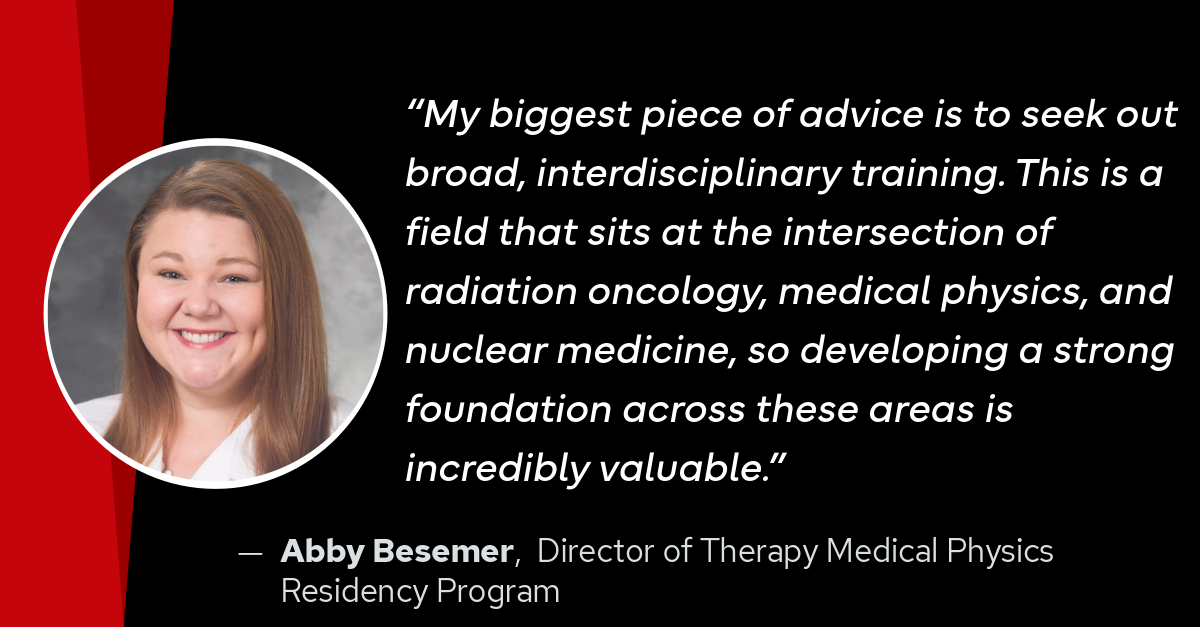
My biggest piece of advice is to seek out broad, interdisciplinary training. This is a field that sits at the intersection of radiation oncology, medical physics, and nuclear medicine, so developing a strong foundation across these areas is incredibly valuable. It’s also a highly collaborative clinical workflow that involves working closely with physicists, physicians, technologists, nursing, radiopharmacists, etc., so gaining experience working in multidisciplinary teams can be very helpful. I would also encourage trainees to take advantage of opportunities to get involved in research or clinical projects in theranostics early on, since the field is growing rapidly and there are many exciting opportunities to contribute and help shape how it develops.