1. Can you please introduce yourself?
John Floberg, Department of Medical Human Oncology, Associate Professor (CHS), Director of Clinical Theranostics, Department of Human Oncology
I majored in physics at a small liberal arts school, Carleton College. My advisor there was Kris Wedding, a graduate of the University of Wisconsin Medical Physics department. She introduced me to the field of Medical Physics and helped mentor me through the application process for MD/PhD programs.
I completed the Medical Scientist Training Program at the University of Wisconsin, earning my PhD in Medical Physics in 2012, and my MD in 2014. I first learned of theranostics while working in Jamey Weichert’s lab as a graduate student.
After completing my MD/PhD I chose to pursue a career in radiation oncology and matched at Washington University in St. Louis for residency. I completed a research fellowship there, focusing on the biology underlying clinical PET imaging findings. I also received extensive clinical training with radiopharmaceutical therapies. That training led nicely into my early career here at the University of Wisconsin.
2. Can you talk about your role in theranostics and particle therapy?
I’m a radiation oncologist specializing in genitourinary cancers. Clinically, I manage the radiopharmaceutical therapies for men with metastatic prostate cancer with colleagues in radiation oncology, nuclear medicine, and medical oncology. This includes clinical management of patients under treatment as well as being responsible for the radiation dosimetry evaluation for these patients.
I also serve as the Director of Clinical Theranostics for the Department of Human Oncology. In this role I have worked to develop a multidisciplinary approach to managing patients undergoing radiopharmaceutical therapies, combining the strengths of radiation oncology, radiology and nuclear medicine, and medical physics, in close collaboration with medical oncology, to provide the best possible care to patients undergoing these therapies. A component of this has also been the development of a clinical radiopharmaceutical therapy dosimetry program.
I also am integrally involved with clinical trials utilizing radiopharmaceutical therapies. I am a national PI of an NCI trial, will be the local PI of an upcoming trial in prostate cancer, have helped recruit patients to several other trials, and co-lead the theranostics disease-oriented team.
3. What aspect of theranostics and particle therapy most excites you? What are you looking forward to in the next few years?
I believe personalized radiation dosimetry holds tremendous potential and will allow us to better utilize these therapies and maximize the benefits patients receive from them. This is a very new area clinically, and I am hopeful that the next couple years will generate the data we need to take full advantage of this.
I am also excited about the many new potential therapies that I believe will be available to patients in the next few years.
4. Do you have any advice for students and trainees who are looking to follow your career path and get involved in the field?
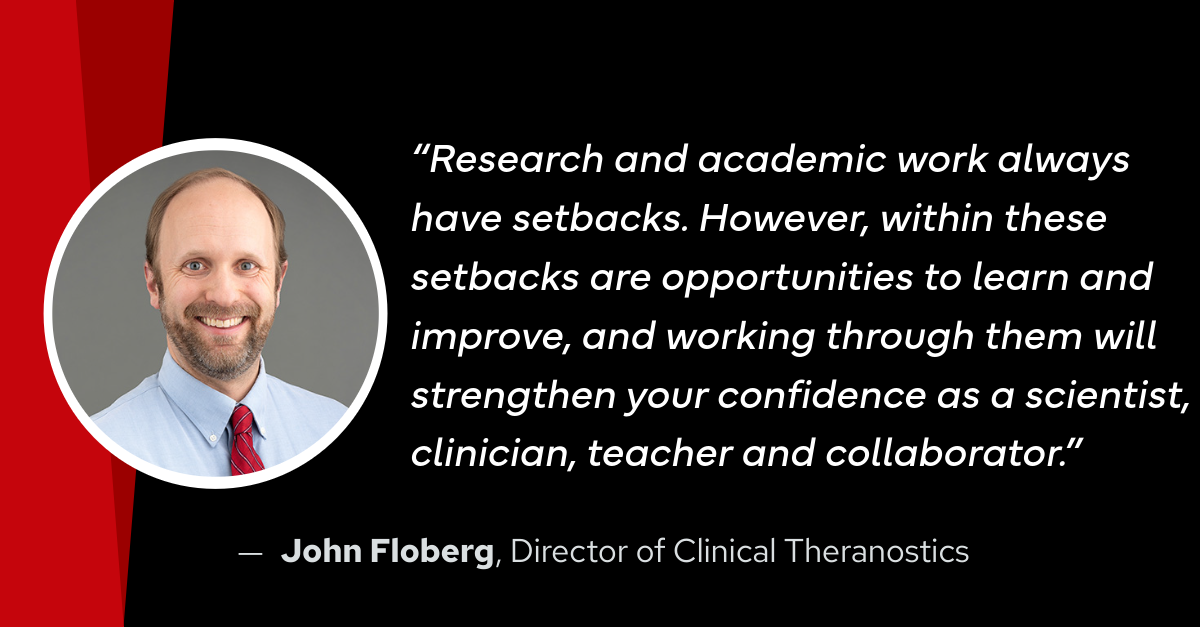
Stay persistent. Research and academic work always have setbacks. However, within these setbacks are opportunities to learn and improve, and working through them will strengthen your confidence as a scientist, clinician, teacher and collaborator.