Lab access is restricted to scheduled users only.
Please schedule usage at least 24 hours in advance
All work areas need to be wiped down with 70% ethanol before and after each use.
All instruments must be scheduled 24 hours in advance through iLab.
If you have any trouble scheduling equipment, please send us an email at CPLabAnalytical@office365.wisc.edu
Cancer Pharmacology Lab offers a wide variety of services to further your research.
More about Cancer Pharmacology
Services
This is an accordion element with a series of buttons that open and close related content panels.
Sample Acquisition
The Cancer Pharmacology Core Sample Acquisition Service is a Biosafety Level 2 laboratory providing accurate processing, temporary storage and/or shipment of study samples from clinical trials conducted by UWCCC investigators.
All samples received are entered into the OnCore Biospecimen Module to allow efficient tracking of the Cancer Pharmacology Core sample inventory.
Shipping
Staff are certified to ship the following Hazardous Materials:
Class 6 – Division 6.2: Infectious and Biological Substances
Class 9: Dry Ice
Exempt Human and Animal Substances
Equipment for sample processing and storage
| Storage Equipment | UH/CSC | EMC |
| -80°C freezer | 2 | 1 |
| -70°C freezer | 1 | |
| -20°C freezer | 1 | 1 |
| Refrigerator | 1 | 1 |
| Processing Equipment | UH/CSC | EMC |
| Biosafety cabinet | 2 | 2 |
| Microcentrifuge 20R | 1 | 1 |
| Allegra Centrifuge (up to 3500 xg RCF) | 2 – Allegra X-22R | 1 – Allegra X-30R |
| Large Centrifuge (up to 5000 xg RCF) | 1 – Allegra X-15R | 2 – Avanti J-15R |
The freezers are continuously monitored 24 hours per day by the Sonicu Web Alarm system. The system automatically contacts multiple staff in the event of a temperature going out of range. The freezer probes are certified every 2 years.
Centrifuges are maintained annually by the manufacturer (Beckman). They are all capable of refrigeration.
They all have settings for low brake or no brake.
BSCs are certified annually.
Kit Drop Off
Please fill out the Kit Drop Off form indicating that you have dropped off a kit and include the study number and the intended use date.
K4/513 Lab access is restricted to primary lab staff when working with Pandemic Human Samples.
Kit drop-off will be on cart outside lab.
Kits should be left on the cart outside of K4/559 before 4:30pm 2-7 days ahead of visit.
Staff must be notified of any specimens being dropped off by calling 263-5369, or ahead of time by emailing cplabsas@medicine.wisc.edu.
Phamacokinetic Assays
Major instrumentation for analytical assays are HPLC, LCMS and LCMSMS. These assays may be performed in any substrate including plasma, serum, urine, whole blood, erythrocytes or tissue.
In addition to the currently available assays listed below, the Cancer Pharmacology Core will develop, validate and run almost any assay needed in your research.
| Compound | Method |
| Atovaquone | HPLC UV |
| Capecitabine & metabolites (5FU, DFCR, DFUR) | HPLC UV |
| Erlotinib | LC-MS/MS |
| Exemestane | LC-MS/MS |
| Genestein & Daidzein | HPLC UV |
| Meclonazepam | HPLC UV |
| Paclitaxel & Docetaxel | HPLC UV |
| Perifosine | LC/MS |
| Perillic acid & Perillyl alcohol | HPLC UV |
| Phenylephrine | HPLC UV |
| Polyamines | HPLC Fluorescence |
| POMx | HPLC UV & LC-MS/MS |
| Ribociclib | LC-MS/MS |
| Saquinavir | LC/MS |
| Talazoparib | LC-MS/MS |
| Temozolomide (TMZ) and 5-(3-methyltriazen-1-yl) imidazole-4-carboxamide (MTIC) | LC-MS/MS |
| UAB30 (Plasma) | LC-MS/MS |
| UAB30 (Urine) | LC-MS/MS |
Pharmacodynamic Assays
The Cancer Pharmacology Lab will validate and run a variety of PD assays.
For example:
- Various Cytokines
- HIF-1a
- Prostate cancer panel: IGF1, IGFBP3, Testosterone, PSA, Urine 2-Hydroxyestrogen and 16alpha-hydroxyestrone
- TGF1, TGF2
- VEGF pathway (VEGF, bFGF, MIP1, VEGFR1, VEGFR2)
Preclinical Analytic Services
The Cancer Pharmacology Lab provides analytical chemistry services using HPLC or LC-MS to quantify small molecule drugs in user provided biological samples including blood, urine or tissue.
Studies
The Cancer Pharmacology Lab offers the following areas of assistance on studies:
- Advice on appropriate experimental design
- Problem definition and statistical methodology
- Definition of study endpoints
- Sample size requirements
- Definition of data items required
- Determination of randomization and stratification
If necessary and for clinical and population-based studies:
- Selection of study subjects and appropriate control groups
- Recruitment strategies
- Availability of data from related studies
- Design of case report forms
- Monitoring of studies
- Data management or electronic transfer of data from other related studies
- Development of systems for quality control, progress reports, and presentation of interim analyses
- Pharmacometric modeling: Non-compartmental and Population PK
- Determination of appropriate statistical methodology
- Production of final study reports including graphs and tables or other summaries suitable for presentation and publication
- Interpretation of statistical results, appropriate documentation and relevant literature
Equipment
The Cancer Pharmacology Lab offers the following equipment for use by investigators. View charges for associated fees, and log into iLab to schedule equipment.
- Agilent 1100 Series LC/MS with diode array detector (DAD)
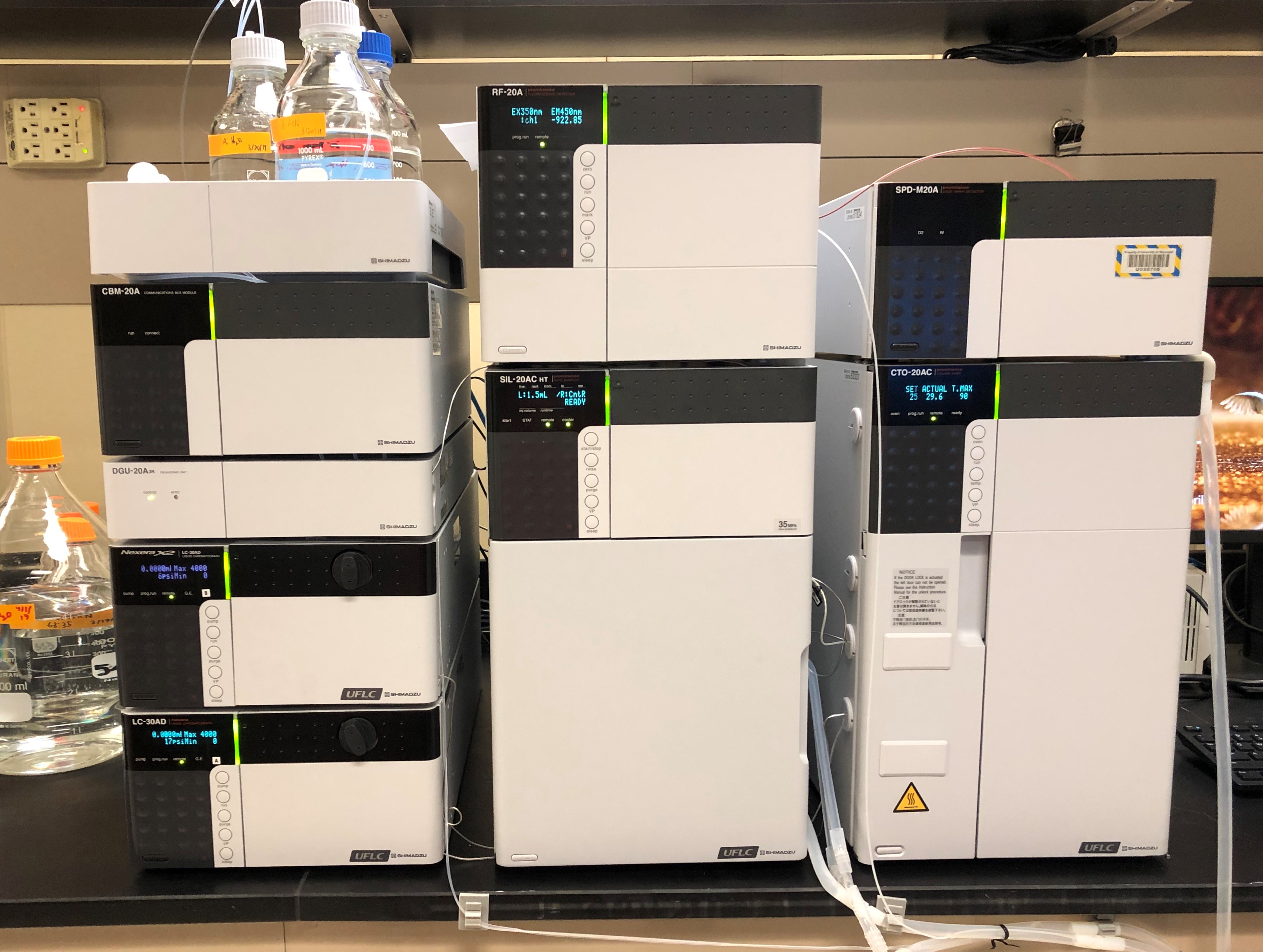
- Shimadzu Prominence HPLC system with DAD, fluorescence, and UV detectors
- NanodropND-1000 Spectrophotometer
- SpectraMax M3 Micro-Plate Reader