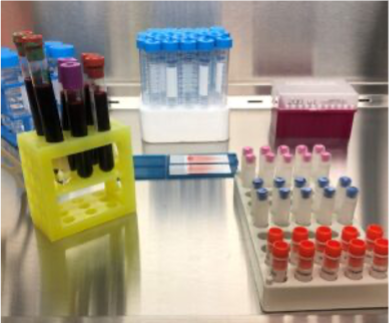
DDC – Cancer Pharmacology Laboratory
The mission of the Cancer Pharmacology Lab (CPL) is to advance cancer research by providing expertise; leadership; and bioanalytical assay development, validation and performance in support of the clinical, translational and laboratory research endeavors of UWCCC investigators.
Leadership
Faculty Leader
Sin Yin (Sean) Lim, PharmD
Facility Manager
Sara Matthiesen
Using the Facility
Lab access is restricted to scheduled users only. Schedule usage at least 24 hours in advance through iLab.
Major instrumentation for analytical assays are HPLC, LCMS and LCMSMS. These assays may be performed in any substrate including plasma, serum, urine, whole blood, erythrocytes or tissue.
In addition to the currently available assays listed below, the Cancer Pharmacology Core will develop, validate and run almost any assay needed in your research.
| Compound | Method |
| Atovaquone | HPLC UV |
| Capecitabine & metabolites (5FU, DFCR, DFUR) | HPLC UV |
| Erlotinib | LC-MS/MS |
| Exemestane | LC-MS/MS |
| Genestein & Daidzein | HPLC UV |
| Meclonazepam | HPLC UV |
| Paclitaxel & Docetaxel | HPLC UV |
| Perifosine | LC/MS |
| Perillic acid & Perillyl alcohol | HPLC UV |
| Phenylephrine | HPLC UV |
| Polyamines | HPLC Fluorescence |
| POMx | HPLC UV & LC-MS/MS |
| Ribociclib | LC-MS/MS |
| Saquinavir | LC/MS |
| Talazoparib | LC-MS/MS |
| Temozolomide (TMZ) and 5-(3-methyltriazen-1-yl) imidazole-4-carboxamide (MTIC) | LC-MS/MS |
| UAB30 (Plasma) | LC-MS/MS |
| UAB30 (Urine) | LC-MS/MS |
The Cancer Pharmacology Lab will validate and run a variety of PD assays.
For example:
- Various Cytokines
- HIF-1a
- Prostate cancer panel: IGF1, IGFBP3, Testosterone, PSA, Urine 2-Hydroxyestrogen and 16alpha-hydroxyestrone
- TGF1, TGF2
- VEGF pathway (VEGF, bFGF, MIP1, VEGFR1, VEGFR2)
The Cancer Pharmacology Lab provides analytical chemistry services using HPLC or LC-MS to quantify small molecule drugs in user provided biological samples including blood, urine or tissue.
- Advice on appropriate experimental design
- Problem definition and statistical methodology
- Definition of study endpoints
- Sample size requirements
- Definition of data items required
- Determination of randomization and stratification
If necessary and for clinical and population-based studies:
- Selection of study subjects and appropriate control groups
- Recruitment strategies
- Availability of data from related studies
- Design of case report forms
Kit Drop Off
Please fill out the Kit Drop Off form indicating that you have dropped off a kit and include the study number and the intended use date.
Lab access is restricted to primary lab staff.
UH: Kit drop-off will be on cart outside lab of K4/559 before 4:30pm.
EMC: Kits should be placed on the shelf labeled with the appropriate day.
All kits should be delivered 2-7 days ahead of visit.
Staff must be notified of any specimens being dropped off by calling 263-5369 at UH, 914-0501 at EMC, or ahead of time by emailing cplabsas@medicine.wisc.edu for either site (please specify which).
Phamacokinetic Assays
Pharmacodynamic Assays
Preclinical Analytic Services
- Pharmacometric modeling: Non-compartmental and Population PK
- Determination of appropriate statistical methodology
- Production of final study reports including graphs and tables or other summaries suitable for presentation and publication
- Interpretation of statistical results, appropriate documentation and relevant literature

First-in-human PK projection
Predict PK in humans, identify FIH dosing regimens using allometric scaling, in vitro-in vivo extrapolation, and physiologically based PK (PBPK) modeling.
PK/PD analysis
Assist in study design and perform PK/PD analysis using appropriate approaches such as non-compartmental analysis (NCA), compartmental PK/PD modeling, and PBPK modeling.
Model-informed dose selection
Use PK/PD simulations to identify model-informed optimal dosing strategies and select appropriate dosing regimens for future clinical trials and special populations, including pediatric patients.
The Cancer Pharmacology Lab offers the following equipment for use by investigators. View charges for associated fees, and log into iLab to schedule equipment.
- Shimadzu Prominence HPLC system with DAD, fluorescence, and UV detectors
- NanodropND-1000 Spectrophotometer
- SpectraMax M3 Micro-Plate Reader
Any published research which received funding from the UWCCC Cancer Center Support Grant (CCSG), including the use of UWCCC Shared Resources to generate or analyze data or conduct clinical trials, must acknowledge the UWCCC. See Acknowledging UWCCC in Publications, Posters, and Presentations. Please acknowledge “UWCCC Circulating Biomarker Core” for any work supported by the CBC. Thank you!
Sample Acknowledgment
“The author(s) thank the University of Wisconsin Carbone Cancer Center DDC Cancer Pharmacology Laboratory, supported by P30 CA014520, for use of its facilities and services.”
The Cancer Pharmacology Lab is proud to offer its services at competitive rates.
You can now pay by credit card using our Online Bill Pay option
Activation and Maintenance Fees
The activation and maintenance fees are used for Protocol-specific training, computer and OnCore database support, equipment maintenance, quality assurance audits, office supplies, dry ice, and on-site meeting attendance associated with the study review, budgeting, activation and maintenance by CPL personnel.
Consumable Supplies
All consumable supplies not provided will be charged at actual cost.
Shipping
In all cases the Sponsor or research group must pay shipping charges. Groups using CPL under a Fee for Service Agreement will negotiate shipping charges on a case-by-case basis.
Select Publications
| Ailawadhi S, Arnulf B, Patel K, Cavo M, Nooka AK, Manier S, Callander N, Costa LJ, Vij R, Bahlis NJ, Moreau P, Solomon S, Abrahamsen IW, Baz R, Broijl A, Chen C, Jagannath S, Raje N, Scheid C, Delforge M, Benjamin R, Pabst T, Iida S, Berdeja J, Giralt S, Truppel-Hartmann A, Chen Y, Zhong X, Wu F, Piasecki J, Eliason L, Dhanda D, Felten J, Caia A, Cook M, Popa McKiver M, Rodríguez-Otero P. Ide-cel vs standard regimens in triple-class-exposed relapsed and refractory multiple myeloma: updated KarMMa-3 analyses. Blood. 2024 Dec 5;144(23):2389-2401. doi: 10.1182/blood.2024024582. PMID: 39197072. |
| https://pubmed.ncbi.nlm.nih.gov/39197072/ |
| Litzow, M.R., et al. (2024). “Blinatumomab for MRD-Negative Acute Lymphoblastic Leukemia in Adults.” N Engl J Med 2024;391:320-33. |
| Blinatumomab for MRD-Negative Acute Lymphoblastic Leukemia in Adults (nejm.org) |
| Mian MY, Sharmin D, Mondal P, Belayet JB, Hossain MM, McCusker P, Ryan KT, Fedorov AY, Green HA, Ericksen SS, Zamanian M, Tiruveedhula VVNPB, Cook JM, Chan JD.2024.Development of non-sedating benzodiazepines with in vivo antischistosomal activity. Antimicrob Agents Chemother68:e00369-24.https://doi.org/10.1128/aac.00369-24 |
| https://doi.org/10.1128/aac.00369-24 |
| Montgomery KE, Basha M, Nyholm L, et al. (2024) Exploring Inflammation and Stress as Biological Correlates of Symptoms in Children With Advanced Cancer: A Longitudinal Feasibility Study. Journal of Pediatric Hematology/Oncology Nursing. 2024;41(3):157-171. doi:10.1177/27527530231214544 |
| Exploring Inflammation and Stress as Biological Correlates of Symptoms in Children With Advanced Cancer: A Longitudinal Feasibility Study – Kathleen E. Montgomery, Mays Basha, Leah Nyholm, Corey Smith, Gene Ananiev, Alexander Fedorov, Amita Kapoor, Roger Brown, Christian Capitini, Kristine Kwekkeboom, 2024 |
| Gunder, L. C., Johnson, H. R., Yao, E., Moyer, T. H., Green, H. A., Sherer, N., Zhang, W., & Carchman, E. H. (2023). Topical Protease Inhibitor Decreases Anal Carcinogenesis in a Transgenic Mouse Model of HPV Anal Disease. Viruses, 15(4), 1013. https://doi.org/10.3390/v15041013 |
| Viruses | Free Full-Text | Topical Protease Inhibitor Decreases Anal Carcinogenesis in a Transgenic Mouse Model of HPV Anal Disease (mdpi.com) |
Locations
Clinical Science Center (UW Hospital and Clinics)
Main Lab: K6/571
SAS Lab: K4/559
Eastpark Medical Center
Research Specimen Lab
Phone: 608-914-0501