DDC – Small Molecule Screening Facility
The Small Molecule Screening Facility (SMSF) fosters collaborative drug discovery research between chemists, biologists and physician scientists that leads to the identification of new small molecules that inhibit disease targets and phenotypes in biochemical and cellular models relevant to any therapeutic area.
To learn more about our services and discuss your needs, contact Spencer Ericksen or Song Guo. Free estimates provided.
Leadership
Faculty Leader
Co-Interim Facility Managers
Spencer Ericksen & Song Guo
Computational Modeling and Virtual Screening
Spencer Ericksen, Ph.D.
Using the Facility
HTS Services
High-throughput screening (HTS) combines robotic liquid handling and assay miniaturization with data analysis software and computational methods to identify hit compounds and their families. Users can leverage our instrumentation and expertise to screen libraries of over 500,000 “drug-like” small molecules, 300,000 natural product fractions, or 18,000 human siRNAs. Radioactive assays and substances requiring a higher containment level than BSL2 are not supported. SMSF staff are available to assist in assay development, assay validation, assay implementation, data analysis and chemical informatics.
How much will it cost? This depends on the specifics of the assay, availability of reagents from the client lab, and the number of compounds or RNAi pools screened. Generally HTS assays cost from $0.10 to $1.00 per well, including reagents and the time of the SMSF scientists.
A terrific resource on HTS assays is the NIH-supported Assay Guidance Manual. Signal/background ratio (S/B) and well-to-well variability (CV) are key variables in HTS. See the HTS Assay Validation Chapter in the Assay Guidance Manual for a discussion of how the statistical robustness of an HTS assay will be determined by SMSF scientists.
Once an assay is demonstrated to be statistically robust, a small pilot screen of 100 – 1,000 compounds may be run in duplicate plates to confirm assay reproducibility and assess the hit rate. The client may then make a decision as to how many compounds to screen from the in-house collection.
After completing a primary HTS, clients typically will have several screening positives or “hits” to follow-up in secondary screens. Subject to compound availability, SMSF will provide clients with 1 µl of each selected screening hit (~5 µg). If you require more than 1 µl, SMSF stay may assist you in ordering it directly from a commercial source.
In addition to secondary assays, we recommend SMSF services for hit identification and triage, to evaluate the compounds, and assist in planning the follow-up procedures.
Specialized Libraries
Selleck Cell Cycle
A collection of 509 compounds that target various proteins and processes in cell cycle signaling.
MedChemExpress FDA-Approved Drug Library
A collection of 2,613 compounds that are FDA-approved for a wide variety of indications.
Selleck Kinase Inhibitor Library
The Selleck Kinase Inhibitor Library is a unique collection of 1,814 kinase inhibitors.
Tocriscreen 2.0
The Tocriscreen 2.0 Library is a collection of 1,280 biologically active compounds.
Updated: Selleck FDA Approved Drug Library
The Selleck FDA Approved Drug Library is a collection of 2580 FDA-approved drugs.
Selleck Epigenetics Compound Library
The Selleck Epigenetics Library is a collection of 128 compounds
Enzo Screen-Well Bioactive Lipid Library
The Screen-Well™ Bioactive Lipid Library contains 195 bioactive lipids. This includes:
GlaxoSmithKline (GSK) Protein Kinase Inhibitor Set
The Protein Kinase Inhibitor Set (PKIS1 and PKIS2) consists of 868 small molecule kinase inhibitors that have been published by GSK
NCI
More information about these libraries can be found on the NCI/NIH Developmental Therapeutics Program website for Synthetics and Pure National Products Repositories and Basic Chemical Data.
TimTec Anti-Infectives
The Anti-Infectives Library includes 960 molecules and contains low molecular weight, drug-like molecules with scaffolds found in antiseptic agents with anti-bacterial (Gram+ve and Gram-ve), anti-fungoid, anti-microbial activities.
Diversity Libraries
Life Chemicals
(received #1- January 2009, #2- October 2009, #3- November 2015, #4 – October 2016)
The Life Chemicals diversity libraries (LC-1, LC-2, LC-3, LC-4) total 100,000 diverse compounds, arrayed in subsets of 25,000. Each set was selected for diverse coverage of chemical space and general drug-likeness. Available for screening as each subset or the full library.
Maybridge
(received October 2008)
The Maybridge HitFinder collection consists of 14,400 compounds representing the drug-like diversity of the Maybridge compound catalog.
MLPCN: NIH Molecular Libraries Probe Production Centers Network Diversity Library
(received May 2014)
The MLPCN library consists of 340,364 small molecule probes, covering a wide range of chemical space.
NCI NExT Diversity Library
(requested as needed from NCI for oncology-related HTS campaigns that received funding through a peer-viewed process)
The set contains a variety of chemical scaffolds across ten commercial suppliers, while keeping within the boundaries of drug-like chemical space. The collection includes a total of 83,536 compounds.
Natural Product Libraries
The NCI Program for Natural Product Discovery (NPNPD) Prefractionated Library
The NPNPD Prefractionated Library is a collection of >295,000 partially-purified natural product fractions available for use in high-throughput screening.
Assay Ready Plates
Tip-less acoustic liquid handling using the Labcyte ECHO can transfer as little as 2.5nL of DMSO compound solution between plates. This capability allows us to offer assay ready plates for screening at low cost. The resulting plates are ready to accept reagents for screening in your lab or ours. Control wells can be formatted as desired. The SMSF Diversity and Specialized libraries are available in 96-well, 384-well and 1536-well formats in a wide range of plate styles. For additional details or prices, please contact Dr. Tom Polaske (polaske@wisc.edu).
Mechanisms of Action Assays
SMSF offers a broad range of biological profiling assays to help identify a chemical compound’s biological activity and potency including:
- AlphaLisa and AlphaScreen Assays for Biomarkers, Cytokines, Phospho-proteins and more
- AKT Phosphorylation
- Anti-microbial Assays
- Apoptosis Assays
- Cell Migration
- Cytotoxicity and Cell Proliferation Assays
- ERK1/2 Phosphorylation
- HDAC
- NFKb
- Phosphatase Assays (PP1A and PP2A)
- Phosphorylation
- Reporter Gene Expression
- Signal Transduction
- TGF-beta signaling
- Viral Entry
- WNT -Beta Catenin (Super Topflash Assay)
- Wound Healing and Chamber Migration Assays
Custom assay development services are also available.
Seahorse Metabolism Analysis
SMSF is the home of a new Seahorse Bioscience XFe96 Extracellular Flux Analyzer which simultaneously interrogates mitochondrial respiration and glycolysis – in a microplate, in real-time. The XFe96 Analyzer determines in vitro oxygen consumption rate (OCR) and extracellular acidification rate (ECAR) in order to assess cellular functions such as oxidative phosphorylation, glycolysis and fatty acid oxidation.
Mycoplasma Detection
Mycoplasma contamination is one of the most common and serious problems in culturing eukaryotic cells because it alters the phenotypic characteristics of the cells and can negatively impact results. Since mycoplasma is typically not visible and does not respond to antibiotics, an alternative sensitive and reliable detection method is required. Small Molecule Screening Facility (SMSF) uses the R&D Systems Mycoprobe Mycoplasma Detection Kit. This assay is capable of detecting the eight mycoplasma species known to cause 95% of eukaryotic cell culture contamination: M. hyorhinis, M. arginini, M. fermentans, M. orale, M. pirum, M. hominis, M. salivarium and Acholeplasma laidlawii.
The SMSF staff scientists test each client-provided sample in triplicate along side positive and negative controls.
Assays are usually run the week that samples are submitted and data are available within 48 hours of assay completion.
Modeling & Virtual Screening
The SMSF can provide a variety of molecular modeling services like Homology Modeling,
Docking and Scoring, QSAR Modeling, HTS Data Analysis and Compound Selection, Structure-based or Ligand-based molecular design, Protein Molecular Dynamics to guide the identification of small molecules that bind to protein targets of interest.
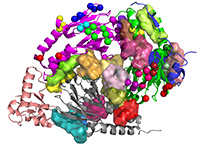
Our virtual screening techniques can be applied to most projects where either a protein target or potent ligand is known. Docking and scoring is most commonly applied in conjunction with synthetic chemistry effort.
We are actively involved in optimization of methods for virtual screening and machine learning approaches for drug discovery. We collaborate with investigators from Biostatistics, Computer Science, Engineering, Biochemistry, and the Center for Predictive Computational Phenotyping on these efforts, and use these novel techniques on our discovery projects.
Hands-on Course in Molecular Modeling and Drug Docking
The SMSF also sponsors a “hands on” 8-week course on molecular modeling with an emphasis on drug design called “Molecular Modeling and Drug Docking” for the UW community to learn how to model the drugs in their targets. The course covers the basics of protein and small molecule modeling using the commercial software Sybyl from Tripos. Several docking programs, such as SurFlex, DOCK and Autodock4, are examined with real examples from the literature.
Preclinical Services
Preclinical in vitro Pharmacology Assays
DDC staff can assist users with characterizing the pharmacological properties of compounds through contracts maintained with external CROs.
Preclinical Pharmacokinetics in Mice
DDC staff can assist users with obtaining PK results in mice through contracts maintained with external CROs.
HTS and Profiling Assay Equipment
Training and Scheduled Walk-up Use Available
Liquid Handling (available in Biosafety Cabinet if sterile transfers needed)
- Formulatrix Tempest contact-free dispenser
- BlueCatBio Blue Washer contact-free plate washer for 96, 384 and 1536 well plates
- Sorenson Benchtop Pipetter 96 and Benchtop Pipetter 96-low volume
- Biotek Microflo peristaltic reagent dispensers
- ThermoFisher Multidrop Combi
Plate Readers and Scanners
- BMG Pherastar Multimode plate reader for absorbance, luminescence, AlphaELISA, and filter-based fluorescence and fluorescence polarization
- MSD MESO QUICKPLEX SQ 120 multiplex cytokine plate reader
- LI-COR Odyssey imaging system (scanner)
- PerkinElmer Operetta high-content imaging system
- BMG Clariostar plate reader for absorbance, luminescence, and fluorescence with monochromator
Walk-up Use Not Available
- Beckman fX Liquid Handling (96 and 384)
- Labcyte Echo 650

Seahorse Metabolism Analysis
- Seahorse XFe96
SMSF operates on a fee-for-service model. User fees pay for staff scientist salaries, consumables and reagents. UWCCC Members receive subsidized rates.
The broad range of services and the individually tailored projects preclude a simple fee schedule. To obtain an estimate for your specific project, please contact us to discuss your needs. There is no charge for meetings or conference calls to discuss project details. Staff scientists will provide an estimate for the project.
Users can now pay by credit card using our online bill pay option
Funding received from the UWCCC Cancer Center Support Grant (CCSG) for published research, including the use of UWCCC Shared Resources to generate or analyze data, or conduct clinical trials, needs to reference the UWCCC. See Acknowledging UWCCC in Publications, Posters, and Presentations. Please acknowledge “UWCCC Small Molecule Screening Facility” for any work supported by the SMSF. Thank you!
Sample Acknowledgment
“The author(s) thank the University of Wisconsin Carbone Cancer Center Small Molecule Screening Facility, supported by P30 CA014520, for use of its facilities and services.”
View the UW Research Expertise website for more information on other UW–Madison laboratory facilities that provide state-of-the-art instrumentation and expert scientific staff.
Location
Wisconsin Institutes for Medical Research
Room 6003 WIMR